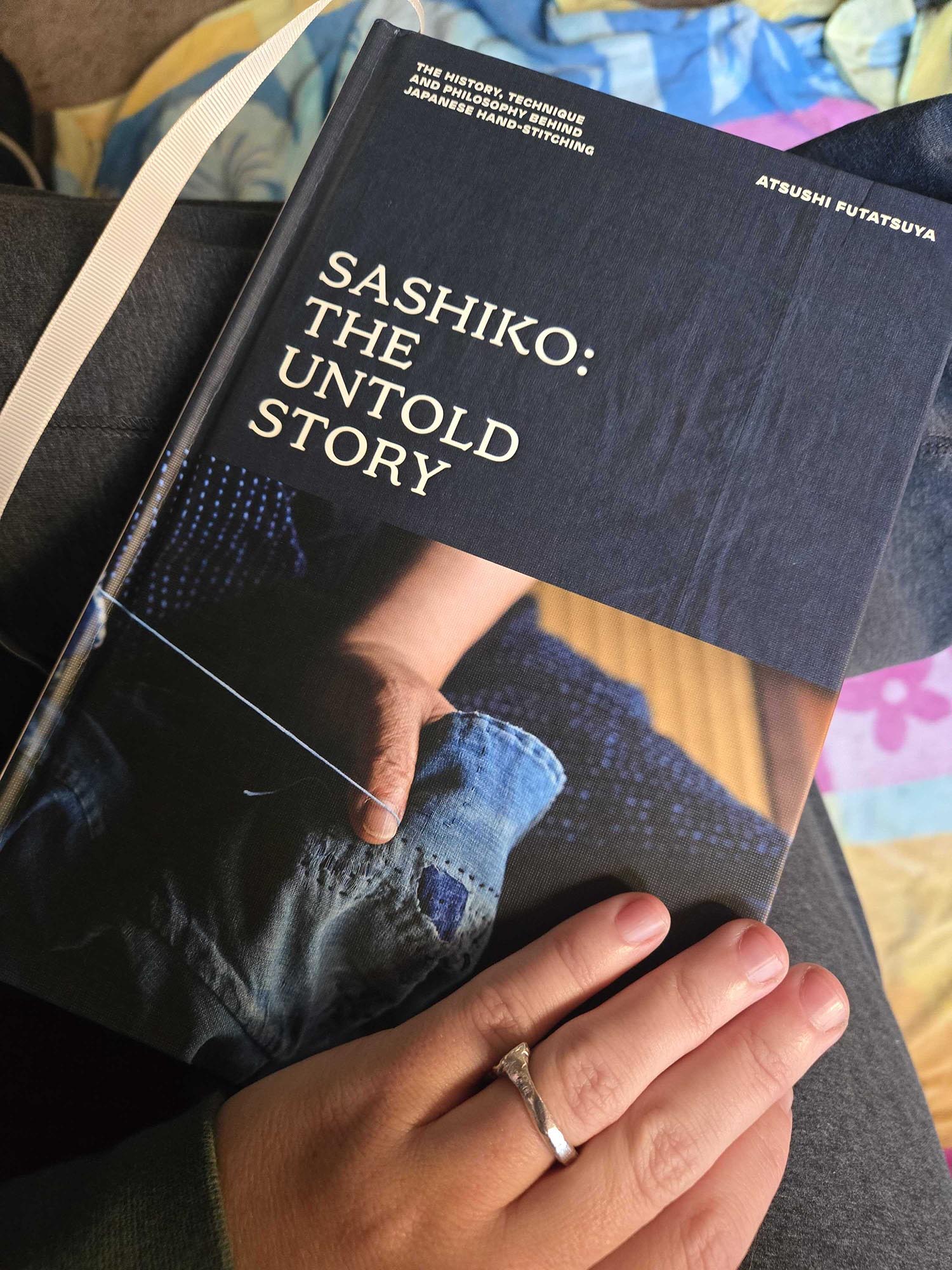
I ordered Sashiko: The Untold Story by Atsushi Futatsuya as soon as it came out earlier this year. It feels apt that I finally opened it 12 hours after finishing an embroidered data visualization I'd been working on since June.
I knew that it wasn't a practical guide to Sashiko. I was expecting a historical and sociological account of an embroidery practice. That's not completely wrong, but it misses what's remarkable about this book: it is the most embodied-human book I have read in a long time, and possibly ever.
With so much discourse around AI writing, it was incredibly refreshing to read a book with the clear purpose of communicating something both deeply human and culturally specific to other people. Futatsuya grew up in Japan in a family that made a living through Sashiko, in the wake of a Sashiko revival his grandmother played a key role in. This embroidery practice that he knows in an embodied way as a practitioner steeped in that culture has reached a level of mass-market cachet in the west. This process has involved simplification and misinterpretation by the English-speaking world. In telling a story of Sashiko as he intimately knows it, Futatsuya uses his perspective as a Japanese man who immigrated to America to attempt a more thoughtful and nuanced set of cultural translations that set the record straight.
The book does not follow the typical format of alternating sections of memoir with sections that purport to offer a factual and objective account of the craft or cultural practice under discussion. Instead, each page or spread can almost stand on its own as a short essay, and these essays are organized thematically into chapters. There are a handful of personal anecdotes, but much of Futatsuya's own story is only visible between the lines. A single sentence about no longer working for his family business in Japan hints at a great deal of unspilled tea, but going there would not further the purpose of the book and so he does not. At the same time, the entire book is unambiguously written from Futatsuya's own perspective, as he explicitly states throughout. There are places where he grapples with the fact that his perspective has changed over time, and is likely still evolving. The chapter on cultural appropriation is particularly striking this way, as Futatsuya grapples with reconciling his complicated feelings about "ownership" when it comes to craft practices with the effects of capitalism, alongside a nod towards intersectionality with his own complicated position in the Sashiko ecosystem.
Sashiko: The Untold Story touches on numerous themes that resonate beyond the craft-oriented parts of my life. His surprise at discovering that a collaborative Sashiko project could work despite (or perhaps because of) the different individual styles of the stitchers reminded me of humanities scholars' first experience moving beyond single-authored work. He has some poignant reflections on the power of the English language, the way it shapes a globalized understanding of culturally-specific practices, and the tension between living a life of deep immersion in craft and living a life where high proficiency in English is a priority. These themes are also present in the MultilingualDH thread of my job. While the words "venture capital" never appear in the text, there are several expressions of concern about the supply chain of craft work, and the need to protect small suppliers of high-quality tools and materials, because materials shape the possibility space of the craft. It reminds me of a blog post from my local yarn shop laying out their decision to no longer stock VC-owned brands to play their part in supporting the fiber-art supply chains that align with their values. It also makes me think more expansively about how this phenomenon affects other kinds of craft, including the technical and data ecosystem for computational text analysis work. How long before AI plays a bigger role in software development than people, and what impact will it have to be working with tools that were not intentionally and deliberately crafted by a person for a purpose? Even more immediately, how will it shape the kind of scholarship that can be done if expensive, locked-down vendor-provided text analysis platforms become the only viable way to work with large corpora of in-copyright materials? It's a moment for confronting supply chains as a force in our lives, and I'm looking forward to Miriam Posner's new book on exactly that topic, coming out this upcoming week.
As soon as I finished Sashiko: The Untold Story, I ordered a copy for a friend, and offered my copy to my collaborators on a "Pants Manifesto on AI and Education" project, for them to borrow and read. My only regret with this book was that my first encounter with it was all at once; I'd recommend not making the same mistake, and reading it one essay at a time. Maybe one a day, maybe saving them for those days when you really need to step away from all screens and read something deeply and beautifully human.
To close, a quote from the final chapter on the future of sashiko:
It is slow in an age of speed, tender in a time of disposability, ordinary in a culture obsessed with the extraordinary.
Hand-stitching is not rebellion. It is remembrance. A whisper into the fabric of time: we were here, we cared, we stitched.