Until this academic year, I've reliably done a quarterly write-up of what I've been up to, but fall quarter this year ended with a set of awful parenting things that have made the rest of the academic year a struggle, if I'm honest, and kept my aspirations modest. I ended up taking some time off to deal with those things in the winter and spring, only to get "elder care" added to the mix. Especially in an era of AI and eternally shrinking budgets, when it feels like all stories of navigating work and life are horror stories, I am beyond grateful at how supportive, flexible, and understanding all my bosses and coworkers have been. I do not take it for granted.
Textile Makerspace & YarnLab
We've done a lot with the former computer lab that's become a flourishing Textile Makerspace, but it is -- at the end of the day -- a small former departmental computer lab with a cabinet and some storage boxes. It feels a little tight in there with more than four people.
For years, I've tried to pack everything in there -- the standing-height cutting table, a couple sewing machines, a serger or two, a coverstitch, an embroidery machine, a computer with a Cricut, an ironing board, and at least two knitting machines. There was a storage box for hand embroidery, and a thread rack for machine embroidery. The rolls of canvas we inherited a couple summers back were stashed under tables or in corners. I'd given up my desk for a floor loom in my office. We made it work, if barely.
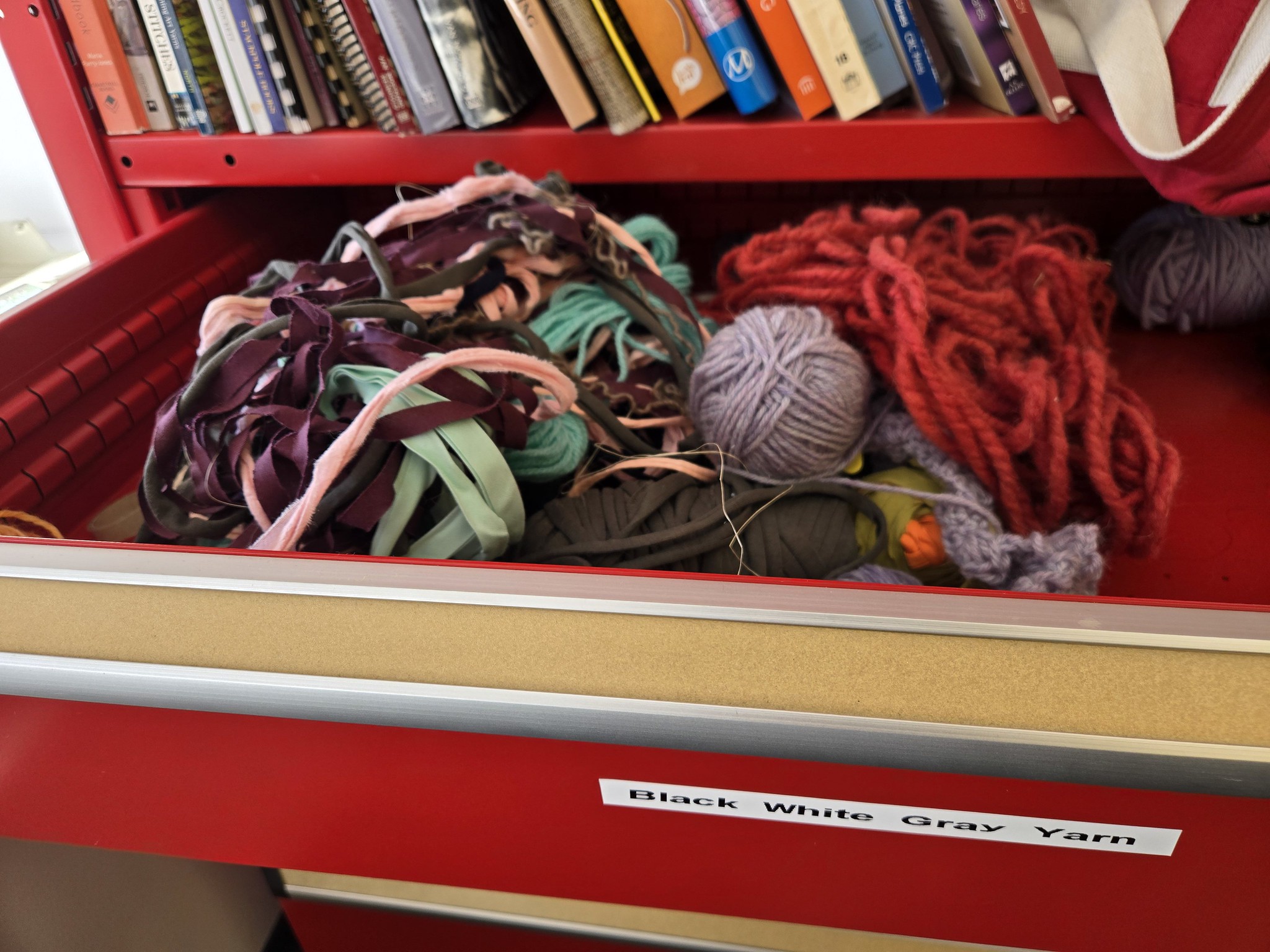
The offer of space in a reimagined and revitalized CESTA felt like an answer to my prayers -- but I wanted to make sure that the new space didn't detract from the value and usage of the original space. So instead of running two Textile Makerspaces, I made the decision to narrow the focus of each: the Textile Makerspace in Pigott would continue its longstanding role as a campus sewing hub, and I'd move all the yarn-based crafts -- which had always been a little marginalized in the Textile Makerspace -- over to Wallenberg Hall as part of the new YarnLab space in CESTA.
Another useful feature of YarnLab is the fact that, by being a part of CESTA, it's open during business hours during the week. I didn't succeed in arranging staffed hours this year, but I'd love to in the future. Not having staffing means it can be a resource for people who already know what they're doing, but my goal with the Textile Makerspace has never been to create an "insiders-only" space. I'd love to add staffed hours so people feel like they can come and learn with actual human assistance, which made all the difference for me as I was learning these crafts and struggling to translate videos to what I was doing with my hands.
YarnLab is much more spacious than the Textile Makerspace, and we've used it as the locale for various workshops over the course of the year, including an intro to machine knitting with Carson Holgate, intro to knitting with Snowden Becker, and intro to embroidery with Margarita Nafpaktitis. People organize their own events, inviting their friends to join them for crafting over lunch. I don't make a big deal about the fact that I'm responsible for the place when I go there, and I've often enjoyed quietly pulling up a chair and just watching the life of YarnLab unfold while I work -- though offering to help if someone seems confused or looking for something in particular.
I got through this year's staffing on the fumes of the June 2024 Making@Stanford funding. Ironically, in the fall I knit myself a sweater data visualization of all the funding I've received since starting the Makerspace -- and I ended it on a high note after that influx of funding and associated staffing capacity. Budgeting, fundraising, and event planning are not my greatest strength, so I've been incredibly fortunate to enlist German / Medieval Studies librarian Kathleen Smith as manager of those things for the Makerspace and YarnLab. I'm hopeful we'll be able to figure out some kind of plan for the Textile Makerspace and YarnLab going forward.
Existing Projects
This year the Data-Sitters Club got stuck. After DSC 23: Dawn of the Coasting AI, we wanted to do another book talking about AI more generally, and it took us a while to schedule the meeting that would form the conversational basis for the piece. We'd also shared a community survey about AI in DSC #23, and wanted to write up the results. Writing this DSC book wasn't bringing any of us a lot of joy, but we did finally publish DSC #24: Anouk and the AI Surprise, led by Anouk Lang. That same week, we got DSC Little tl;dr #2: Forming Your Corpus out the door, and I also wrote up DSC Little tl;dr #3: Getting 'AI Ready' with Textiles, about how I've been doing drop-in sessions for other classes using some of the techniques I teach in Data Visualization with Textiles (more on that later).
Spring quarter being what it's been, I still haven't made a ton of progress on the next DSC book I have in mind (something about fine-tuning the BERT model to try to classify kids vs. our teen protagonists vs. adults in the BSC books), but that's the next one in line.
There's also a couple new tl;dr forthcoming. Working with Slavic PhD student Alyssa Virker, it really became clear how much #DSC 20: Xanda Rescues the Topic Modeling Disaster is an intermediate book, not really something you can get started from scratch with. Alyssa has written a pitch-perfect tl;dr on using the Terminal on Mac, and she's got another in the works explaining the conceptual basics of topic modeling. It is an absolute pleasure to collaborate on a project with a student who so perfectly understands what you're going for, and writes something so much better for the task than you could've done yourself. I can't wait to share it.
Kathryn Starkey's Global Medieval Sourcebook is almost almost almost done. It is so close to done that we were able to finally shut down the very last Drupal zombie left to me by my predecessor, over seven years ago. Because the Google Analytics account was registered to my predecessor who left very little documentation, launching the new site has given us our first insights into who's using the site and how. To be clear, there is still work to do: 50-some texts still need a PDF and web-based version. But we reached the point where the project needed to move forward instead of waiting for those texts, so this summer I'll be sorting out a more realistic, affordable process for creating those remaining PDFs and any future ones. German Studies grad student Nino Martin has been a wonderful collaborator on the project of trying to get this new site off the ground and moving things ahead, and we'll be presenting together at the ACH conference this summer. To celebrate the Global Medieval Sourcebook's relaunch as a static 11ty site, Kathryn and I talked about the project's history and future at CESTA this spring.
Davis Tantillo's French book reviews project has been on hold this year as he sorts out the direction of his dissertation, but I'm looking forward to supporting whatever digital angle he decides to take as part of that undertaking.
The Jewish cookbooks project with Eitan Kensky hasn't had any new developments this year, but he's continued to acquire them, and once we have a big enough collection of new material, it'll be fun to revisit.
A project that started some time ago, Cristian Soler's' Medieval cartography visualizations for a translation / critical edition that he's been working on, is close to done thanks to help from Simon Wiles. A few small tweaks, and it should be ready when the book goes to press -- and long-term sustainable, as a static visualization.
Tania Flores's Flamenco letras project had a big moment this year with an in-person conference in December at CESTA. Her team's work on that database continues, and has served as inspiration for Gary Huertas's project on Cumbia, which he'll be presenting at the ACH conference this year.
Alyssa Virker's Ukrainian Poetry on Social Media during the Russia's Full-Scale Invasion Against Ukraine project has reached the point where it could use some new DH methods, so we've been working together to look at her data in different ways. The Data-Sitters Club pieces are one shareable outcome of that work.
It's been a big year for the SILICON project, including hosting the ATypI conference at Stanford, but as I've had to manage project prioritization, I've scoped my participation to continuing as attendee and note-taker at the Unicode Script Encoding Working-Group when I'm available.
This academic year we continued with the Browsertrix Cloud pilot, and I've been using the tool myself from time to time to help with project archiving, including doing an archiving pass on the old Drupal site for the Global Medieval Sourcebook.
Transkribus, likewise, has continued as a resource for people doing handwritten text recognition, and I'm still the person wrangling this shadow service, allocating seats, and entangled in what feels like an endless Sisyphean paperwork task around invoices.
There's been incremental progress on DLCL corpora this year, non-trivially aided by the new digitization setup in CESTA, with its ABBYY FineReader install on a physical, local computer. (Despite excellent support from the folks running the virtual computer service, ABBYY FineReader persists in lagging and crashing on that infrastructure.) It may still be aspirational to imagine hanging this fall's new grad students a flash drive with computationally-compatible versions of their comps texts, but I'm a lot closer than I've been before to this dream I've had since I started 7 years ago.
New projects
It's always fun to have "repeat customers": those grad students or faculty who you don't hear from for a while, and then they show up with an all-new project idea. I have a longer story and cautionary tale from the new project from Ostap Kin, looking at the Soviet directories of Ukrainian writers. (The cautionary tale is entirely my fault, and I hope it is instructive.) It's coming soon to this blog, and very much in my spirit of "Quinn screws up and then tells people about it so maybe they can screw up less."
Liza Crim's project on Ukrainian herbal remedies has been taking shape with support from Georgii Korotkov, and we've started talking about next steps for it. The Data-Sitters Club and our tl;dr pieces are helpful here, as with many projects, as part of thinking through methods and corpora.
Regina Pieck and I have been talking with the AI Modeling and Inference team (formerly DH Developers) in the library about a project involving AI support for annotating Nahuatl corpora for scholarly purposes (along with several other ideas for computational support for Nahuatl, suggested by her colleague John Sullivan).
After doing a crash course session on DH tools and methods for the recent-ish Slavic grad students, and talking with Aibarsha Kazhyakpar a little about Kazakh literature, I'm now on the lookout for lemmatizers (or I'd accept a good stemmer!) and other NLP tooling that would let someone do the kind of basic kinds of computational text analysis methods on this particular agglutinative language. I know it's a big ask, and it seems to be one where there's very limited commercial interest (unfortunately). Realistically, it's probably not in scope for us to be doing much to contribute towards developing that tooling, but if anyone takes it on, I will eagerly bang on it in the name of computational Kazakh literature.
Teaching
This was supposed to be the year I taught my #DHRPG class in the winter... then postponed to the spring... then postponed until next year given everything else going on in my life. I am deeply grateful to my department chair, Kathryn Starkey, for reminding me that my job description doesn't require me to teach, and it's okay to sit out a year.
That said, the #DHRPG class needed a major overhaul, and I got pretty close to the start of the quarter before pulling it. Previously, the class was shaped around developing an NEH-ODH grant proposal. The elimination of the Office of Digital Humanities and the cancelation of almost all of the grants (even if they're now being reinstated due to a court ruling, and the NEH is hiring again... at much lower salaries, entry-level only) means that it feels cruel to continue with this structure. Instead, this year I worked out a plan to reimagine the class around Brandon Walsh's wonderful forthcoming book on DH pedagogy paired with The Campus Crisis Toolkit. Students would develop a plan for teaching a DH course in their area of interest, with some kind of collaborative research component. I remain convinced that this class is actually the best one that I teach, and I'm looking forward to doing so next academic year.
For this year's teaching, I have shepherded multiple students through the DH Practicum independent study, including Peter Cheng, who I met in the fall via a library referral. I've worked with him across this whole year on two projects at the intersection of German studies and data science, which can be challenging worlds to reconcile.
I also had another group of students go through Data Visualization with Textiles (now in its 4th year), and that was a particularly enjoyable set to work with this year.
In addition, I did one- or two-class engagements with three different classes: Kathryn Starkey's "Making the Middle Ages: Objects and Meaning Then and Now" (teaching embroidery and weaving), Carmen Thong and Jessica Monaco's "Literary Text Mining" (facilitating a session, funded by a grant to bring the arts into academic classrooms, on data visualization with textiles), and Mark Algee-Hewitt's "Thinking and Making with Data" class (also data visualization with textiles), which is part of the new humanities / data science program.
Writing
It has not been a particularly good year for writing. I have one piece, co-authored with two K-12 teachers, about textile data visualization that's gone through several rounds of edits (to the tune of essentially a full rewrite) and has another round due soon.
I'm on the hook to write a piece on shadow libraries for a volume on modern cultural analytics. I put in the proposal over a year ago, and the US legal landscape has gotten a good deal murkier since with all the AI-related lawsuits.
The one piece of writing that really came together this year was work towards a draft of a Handbook of Textile Data Visualization, which I used with my Data Visualization with Textiles students this spring. It was a culmination of several years of thinking, and despite everything going on in late winter and early spring, I was able to sit down over the course of a couple weeks and put a lot of these pieces together, both conceptually and technically (turning an Obsidian notebook/network into a website).
Talks and events
This year has been fairly light on talks, too. I was a plenary panel speaker on "Infrastructure, Tools, and Standards for Digital Government Information" at the Internet Archive's Information Stewardship Forum (which I still need to write something about -- I had, and have, thoughts.)
There were two SUCHO-related talks, one as a panelist for Cultural Heritage under attack: Saving cultural data in times of crisis" as part of the DHRH Seminar Series The Fragile Record in March, and one as part of the Archived Web as Research Data workshop at Aarhus University in May.
At CESTA, there were the talks on the Global Medieval Sourcebook project in May, and one on #DHmakes and craftivism in January. I wrote that one up on my blog as "Craftivism in a Crisis: Making the Humanities Matter When It’s All Falling Apart". That talk really captures a lot of where my head has been at this year.