Fall quarter starts on Monday, so here's the summer recap:
Textile Makerspace & YarnLab
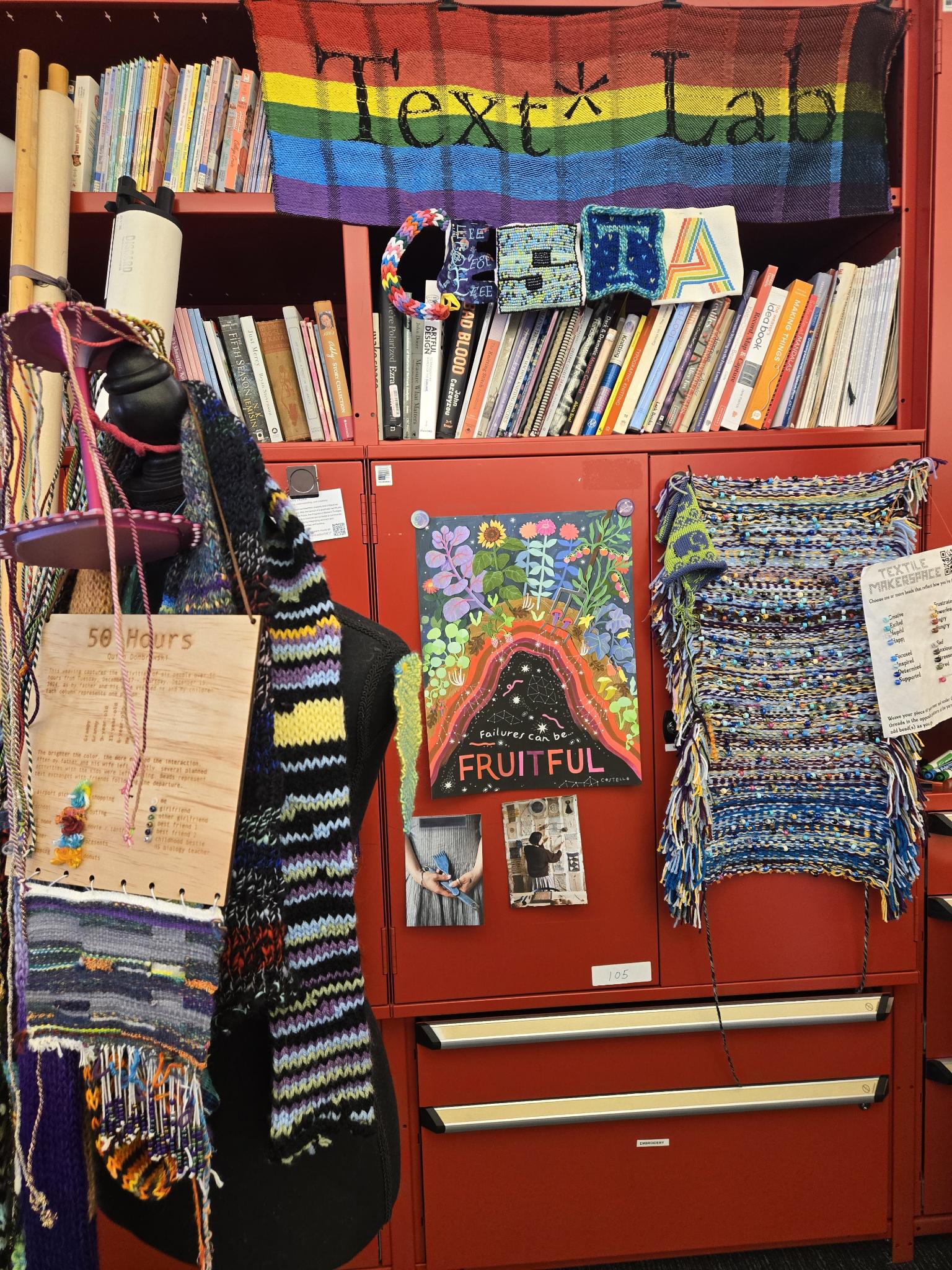
The Textile Makerspace was closed over the summer, trying to hold onto the remaining funds to be able to have some open hours in the fall, as buffer while working out a longer-term plan.
Instead, it became clear that there isn't really a future for the Textile Makerspace in the current campus funding landscape. Its years of flourishing really did depend on the Making@Stanford initiative that now no longer has full-time staff, or a regular grant program to fund the staffing side (though they do have open calls for buying equipment from time to time.)
The Textile Makerspace -- as I conceived of it, and to do what I wanted it to do -- really did depend on it being staffed somehow. I emphatically did not want another locked studio space only open to people who know what they're doing; I wanted the people who didn't know what they were doing, so they could learn, whether or not they could manage to enroll in a class for that. I wanted a place where people could do all those human things that they often feel they need to apologize for in academic spaces: mending, hemming pants, making a quickie Halloween costume. I wanted people to pursue their weird little hobbies and passions, and have just sa tiny bit of support in doing so, through the student staff. Because anyone could come by, I also needed it staffed so that things wouldn't break all the time, or at least that somebody would notice when they did break so I could deal with it.
It was a special place, and people loved it.
Trying and ultimately failing to secure funding for the Textile Makerspace took up a lot of time and energy this summer. Even though it was not at a scale that would've fundamentally changed the situation, I did get some offers for end-of-the-year funds from the Library side, but it was stymied at the last minute due to a baffling problem of me having the wrong kind of funds account to transfer the money.
Shutting down the Textile Makerspace was almost as hard as pulling the plug on the DiRT Directory. At least this time, I'm consoled that people have other options: I've talked with Jacob Ramirez at the GSE Makery, and with some financial support from Steve Collins in Engineering for equipment and some additional staffing to supplement the GSE's continuing funding for student staff, the Makery will be expanding their sewing and machine embroidery options. The student who's worked at the Textile Makerspace for two years will be hired by the Makery with some of that funding, and it also supports a 5-hour/wk student position for YarnLab.
I've been thinking about how to reimagine the room itself, and asking around for input. There's an informal DLCL crafting group, and maybe it can be some kind of home base for them. I'm hoping they'll get some funding as part of the pockets of joy grant CFP, which is the first CFP that's legitimately made me grin, possibly ever. I have some thoughts about what it assumes in terms of infrastructure, but that's a topic for a future blog post.
At the moment, the most likely scenario is that it becomes some kind of knitting machine / weaving atelier for people who've done at least some kind of basic training and certification on those machines, which are extremely fussy and prone to breaking. But perhaps another idea will come to light.
In the meantime, I'm planning a series of fall workshops at YarnLab, and thinking about how to advertise the space (since last year was something of a "soft launch"), and better integrate it into the overall program of activities at CESTA.
Existing projects
Slavic grad student Alyssa Virker wrote two absolutely wonderful Data-Sitters Little Tl;Dr pieces on using the terminal and topic modeling that I'll be publishing very soon. Reading those gave me one of the best feelings you get as a teacher, when a student really got the assignment and nailed it. I hope everyone enjoys them. Fine-tuning BERT for classification problems is still in the works, and over the summer as part of working on another paper, I discovered a better way to do the necessary data acquisition from Fandom wikis.
The Global Medieval Sourcebook is now in a state of almost-done, as we've migrated to a static site but there's still a list of problem texts that didn't have a finished print version done. We're currently sorting out the best way to handle that, and debating issues like how important is the TEI version, really, given the project's current goals and audiences. I'm hopeful that this is the penultimate update for that project before calling it good.
Eitan Kensky and I have come up with a set of next steps for the Jewish cookbooks project, leveraging partly leveraging the book digitization infrastructure at CESTA. We've got some new ideas for analysis, some better thoughts about shaping a more meaningful corpus, and he's got funding to pay a student assistant to help -- all good things!
I've gotten some enthusiastic feedback about the HPC for Humanists project I was working on a few years back, then drifted away from as I wasn't working with people who needed compute at that scale. That's moved it up higher on the priority list of things to revisit as time permits.
Over the summer, I was happy to serve on a small advisory group for a hire in DLSS that would be involved in the ongoing Browsertrix Cloud pilot. I'm looking forward to having that person on board, not least to have someone to think with about how to advocate for the future of web archiving in the library, and how to think about that tool (e.g. internal vs. external use).
Another "shadow service" that continues to operate in that somewhat awkward space is Transkribus. On the upside, this summer I finally managed to get a somewhat complicated invoice processed that dates back to 2020(!). People have been actively using it, and a bit of lightweight management seem to go a long ways. I'm also starting to work on a little prototype of what a full-text dirty-HTR discovery engine for manuscripts and such from Special Collections might look like.
The digital Nahuatl project with Regina Pieck has largely been on hold this summer; there's a group out of UNAM that's waiting for the results of a grant application that could make a huge difference in having the resources to build something larger, including taking a consortial approach. My developer colleagues in the library who would need to be a part have also been tied up with other work, so things have been quiet on that front.
As students come back into town, I'm catching up with them about their projects and progress. Gary Huertas's project on Cumbia has a clearer direction after a summer spent working with collaborators. Tania Flores graduated this year but I'm around to help with cleanup and then an interface for her Flamenco letras project. I've been talking with Liza Crim about designing a corpus for her Ukrainian herbs project. There's a little more cleanup needed for Cristian Soler's medieval world visualizations. And assorted other projects where I'm looking forward to checking in with grad students and seeing how things are going, and if I can help them get unstuck.
Over the summer I've made considerable progress on the DLCL corpora, having discovered that it helps to have specific students and specific exams in mind when compiling these texts, since it makes the whole task feel less tedious and abstract. I still have ideas about pulling in data from DLCL dissertations/syllabi, but it's still in the planning stage.
Writing
A lot of writing -- including some pieces from up to 5 years ago -- is finally making its way through the publication pipeline. "Personal Entanglements and Graceful Relationship Degradation in Collaborative Projects", a piece I wrote with Erica Cavanaugh, had some final edits. Revisions were accepted for "Crafting Data with Textiles in the Classroom" with Jessica Arroyo Solis and Laura Gorrin, so that now goes into the production queue and will be out sometime next year. Lisa Spiro and I wrote up our talk revisiting DH values and, thanks to some generous flexibility from the editors who are already well into things, it'll be appearing in Debates in DH 2028. And for a volume by James O'Sullivan on cultural analytics, I wrote a chapter on legal issues facing cultural analytics work, which gave me a chance to expand and solidify my knowledge of European copyright issues as well as the legal landscape in Singapore (very different than many other places!), which should be useful when chatting with students interested in international collaboration.
Talks and events
I've written earlier about the differences between ACH and DH 2026 this year and what that means for digital humanities as a field. Between those two conferences, I had five talks / workshops over the summer: "This Is How We Fight: Revising Digital Humanities Values" with Lisa Spiro (DH 2026), "#DHMakes: Embodied Craft as Critical Engagement" half-day workshop with Nichole Nomura and Jajwalya Karajgikar (DH 2026), "Reimagining the Global Medieval Sourcebook" with Nino Martin (ACH 2026), "#DHmakes Show-and-Tell Picnic", with Amanda Visconti, Sara Arribas-Colmenar, and Jajwalya Karajgikar (ACH 2026), and "From Scribe to Server: Exploring AI-Supported Workflows for Nahuatl Transcription", with Regina Pieck (ACH 2026).
I'm about a week out from finishing my 8th year at Stanford, and on to week 9. Around the time I started this job, I gave a talk called "The 2040 Plan". If that ends up being how it works out, I'm about 1/3 of the way through my time here. It's certainly food for thought. But at the same time, there's something comforting about the familiar structure of the academic year, and knowing that even if I don't feel like I have things all figured out, I can keep doing things that are helpful and meaningful for people by showing up and seeing what surprises turn up at my office door or in my inbox. Given the state of the world and the havoc AI is wreaking on so many friends' jobs, that alone feels like a gift.