The Network Analysis of the Russian Novels
Yuliya Ilchuk
Project Overview
The project on the network analysis of the Russian novels integrates computational analysis of the network systems with literary analysis of the character-space, and theorization of sociality in social sciences. The network analysis tools were used to test several hypothesis: 1. whether the Russian novels have a clear dichotomy between the nuclear family type and social panorama type of the novel; 2. whether such characteristics of the emerging modernist novel as multi-centrality and multi-perspectivism were the result of the narrative world itself becoming more complex and intricate; or 3. whether the novels captured the socio-political trends of the time and served as models of a heterarchical organization of liberal society. As of the fall 2025, 14 novels (nine realist and five modernist) were selected to test these hypotheses. Since the fully automatic extraction of data from the novel yields unreliable results, the data for the networks have been collected manually by counting the dialogues between the characters. Professor Ilchuk followed the conversational model based on a “speech act” of a character in response to another character or as directed towards the character him/herself (as in the interior monologue). The networks were generated by use of gephi, a free platform for network visualizations. Each network was tested on the number of transitive triads and robustness to understand how stable the connections between the characters are. The novelty of the project is that it opens a new insight into human sociality that cannot be reduced merely to the ethical and political dimension, or to the formal questions of realism and heteroglossia. In Russian novels of the second half of the nineteenth century, the sociality was taking shape in the intersubjective relays and gaps between characters and their relations— relations both to other characters and to things, and more complexly to other characters by way of things, as well as by way of the plethora of images and scenes with which they come into contact. The network analysis of the novel can enhance the traditional humanistic practices of textual interpretation and can be assigned in the undergraduate course on Russian novel.
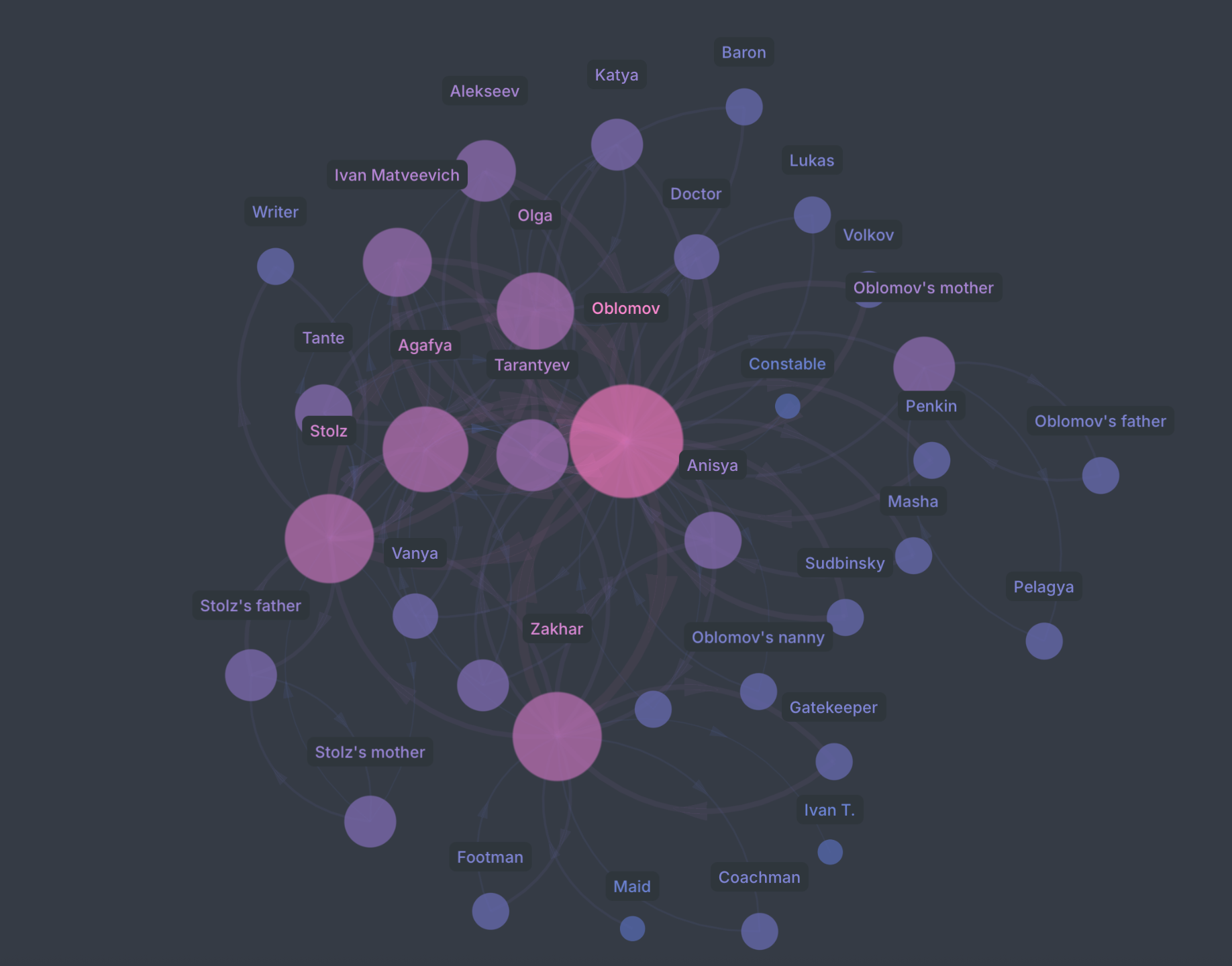
Oblomov
General features: a medium network (35 nodes, 109 edges, network diameter 4, number of communities 3); no orphans (all characters speak or listen); low graph density (9%) and very low clustering coefficient (44%); moderate variance in node degree; eigenvector centrality 5.6
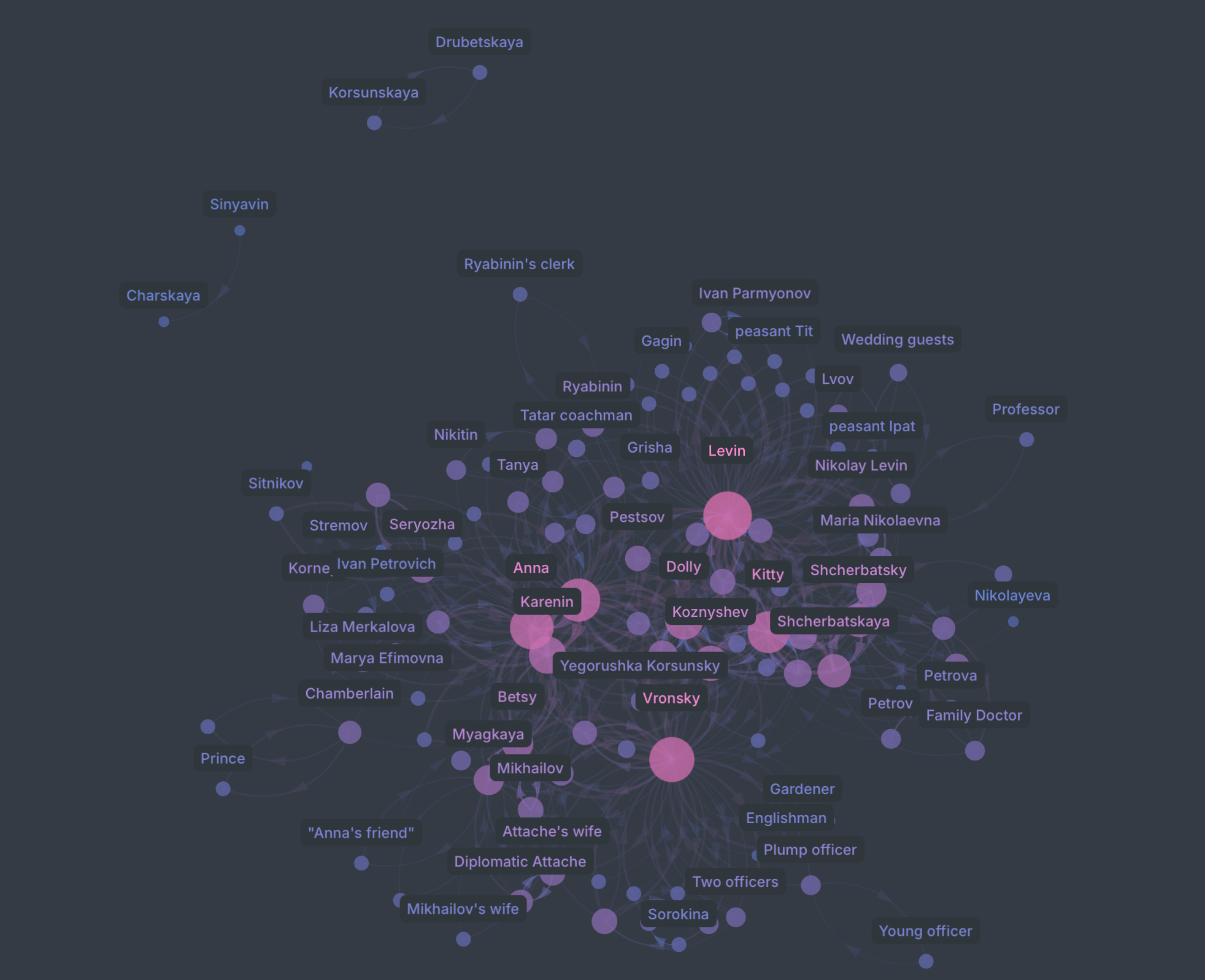
Anna Karenina
General features: a large network (157 nodes, 457 edges, network diameter 6, number of communities 17); only 5% of “orphans” (unconnected characters); very low graph density (3%) and clustering coefficient (38%); moderate average path length (2.8); high variance in node degree; eigenvector centrality 6.37 Large and somewhat diffuse social world with deep interaction between core characters and with passing social interactions between secondary characters • Social interaction dominated by several central characters interacting episodically with a profusion of secondary and tertiary characters • The network naturally splits into two almost equal universes with Stiva and Dolly connecting the two.
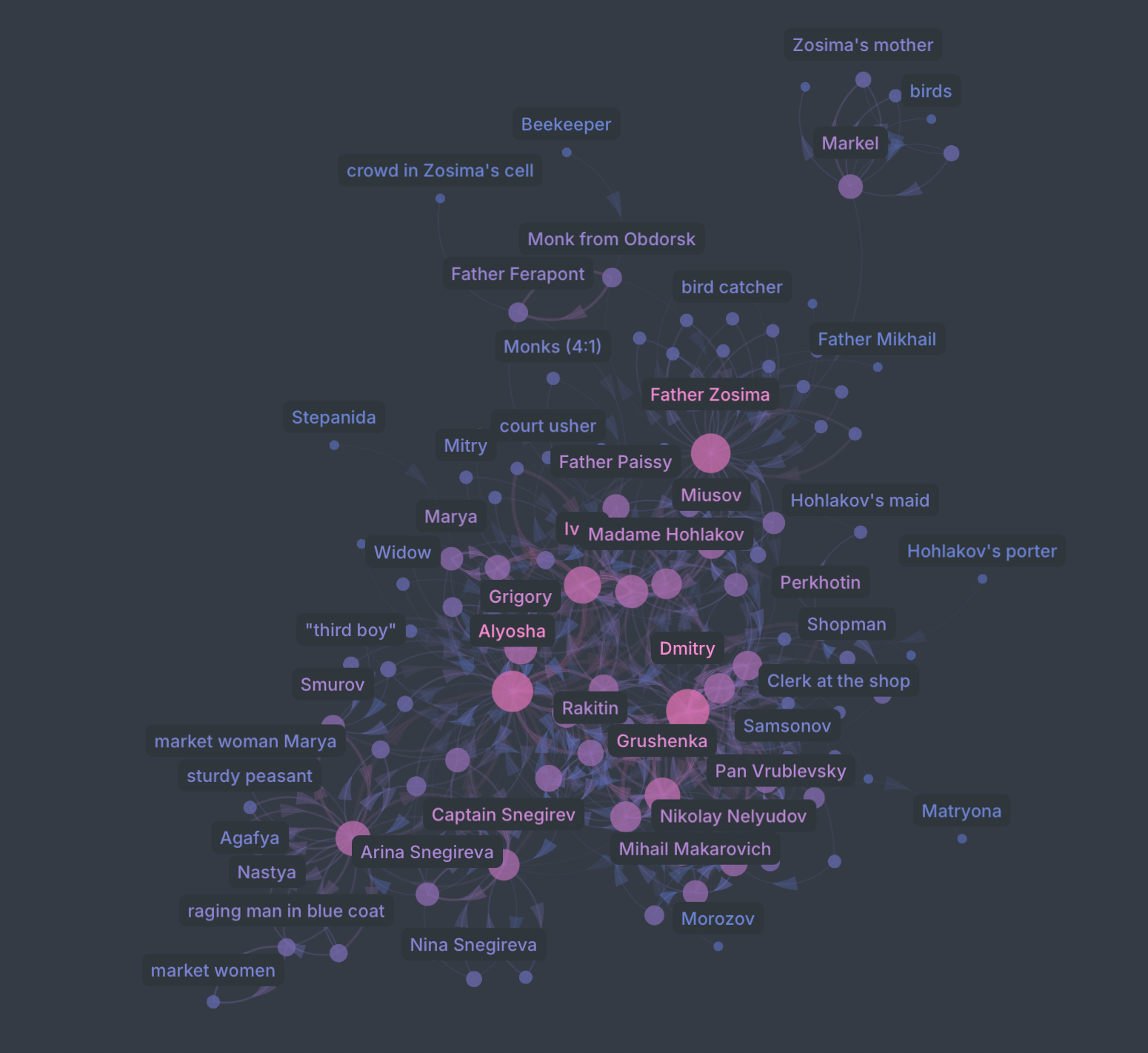
Brothers Karamazov
General features: large network (119 nodes, 453 edges, network diameter 7, number of communities 22); only 5% of “orphans” (unconnected characters); very low graph density (2.5%) and clustering coefficient (31%); moderate average path length (2.86); high variance in node degree; eigenvector centrality 3.28 Large and closely-knit social world with deep interaction between core characters and between secondary characters • Social interaction dominated by several central characters interacting episodically with a profusion of secondary and tertiary characters • The network naturally splits into “Dmitry,” “Alyosha,” “Father Zosima” universes (among the protagonists) and “Kolya Krasotkin” and “Grigory” universes (among the secondary characters).